
PHONE:
0512-58581137 +86-13151198265
E-MAIL:
SKYPE:
zhujingke@hotmail.com
- All
- Product Name
- Product Keyword
- Product Model
- Product Summary
- Product Description
- Multi Field Search

Views: 0 Author: Site Editor Publish Time: 2026-06-14 Origin: Site


Extreme weather serves as the ultimate stress test for your solar assets. You cannot afford to underestimate the power of Mother Nature. Failure to account for localized wind uplift and heavy snow accumulation does not just cause minor damage. Instead, it leads to catastrophic system failures, voided warranties, and massive financial losses.
Generic mounting systems often rely on baseline structural assumptions. These basic assumptions quickly fail under severe environmental stress. For commercial EPCs and asset owners, settling for generic engineering becomes a massive long-term liability.
This guide provides a detailed technical and commercial framework. You will learn how to evaluate a Solar Structure designed specifically for high wind and snow loads. We bridge strict engineering compliance standards, like ASCE 7, with smart procurement strategies. By the end, you will know exactly how to ensure your selected system delivers physical resilience and strong project ROI.
Wind and snow loads represent distinct physical threats: wind creates dynamic uplift and shear forces, while snow causes sustained, crushing static pressure.
Compliance with authoritative standards (e.g., ASCE 7-16 or 7-22) is non-negotiable and must be verified via Professional Engineer (PE) stamped documentation.
Solar roof mounting systems require specialized load distribution strategies to protect the roof integrity while resisting extreme uplift.
Evaluating a structural partner goes beyond price; verifiable wind tunnel testing and site-specific custom engineering are critical shortlisting criteria.
Standardized mounting equipment simply falls short in harsh climates. Regions prone to hurricanes, blizzards, or alpine conditions demand specialized engineering. When structural failures happen, they cause immediate hardware loss. You also face secondary roof damage and prolonged system downtime. We must understand exactly how these forces behave.
Wind creates dynamic, complex threats. It generates negative pressure, known as uplift. This force actively attempts to tear panels away from their mounts. Simultaneously, wind applies lateral drag. This drag stresses structural joints and forces the entire array to shift. You need a highly rigid frame to combat these combined dynamic forces. If the frame flexes too much, the glass modules will shatter under the strain.
Snow loads present an entirely different physical challenge. Snow generates heavy, sustained downward pressure on the array. We call this a static load. When snow accumulates unevenly, it causes drifting. Ice dams form and create severe localized stress. These off-center point loads easily bend standard aluminum rails and compromise the entire system structure.
Insurance providers pay close attention to these climate risks. Commercial premiums now tie directly to the verifiable structural resilience of your mounting equipment. Investing in higher-rated systems mitigates catastrophic failure risks. It also yields significant long-term OPEX savings by avoiding emergency repairs and replacing broken modules.
You cannot build resilient arrays without a strict baseline. In North America, the ASCE 7 standard dictates these rules. The American Society of Civil Engineers publishes "Minimum Design Loads for Buildings and Other Structures." The industry adapts this standard globally to ensure consistent structural evaluation across different climates.
Evaluating load calculations requires high precision. A basic wind speed rating provides a false sense of security. You need site-specific calculations instead. These formulas factor in your local terrain, precise elevation, and the exact building height. A structure near an open coastline faces vastly different pressures than one surrounded by dense urban skyscrapers.
Engineers classify solar systems into specific Risk Categories. These categories assess the danger to human life and the economic impact of a potential failure. A higher risk category dictates stricter safety factors and thicker structural components. You must align your system design with the correct category to ensure regulatory compliance.
Common Mistake to Avoid: Never accept a generic "150 mph wind rated" marketing claim. Demand site-specific calculation reports. They must factor in your local topography and aerodynamic multipliers.
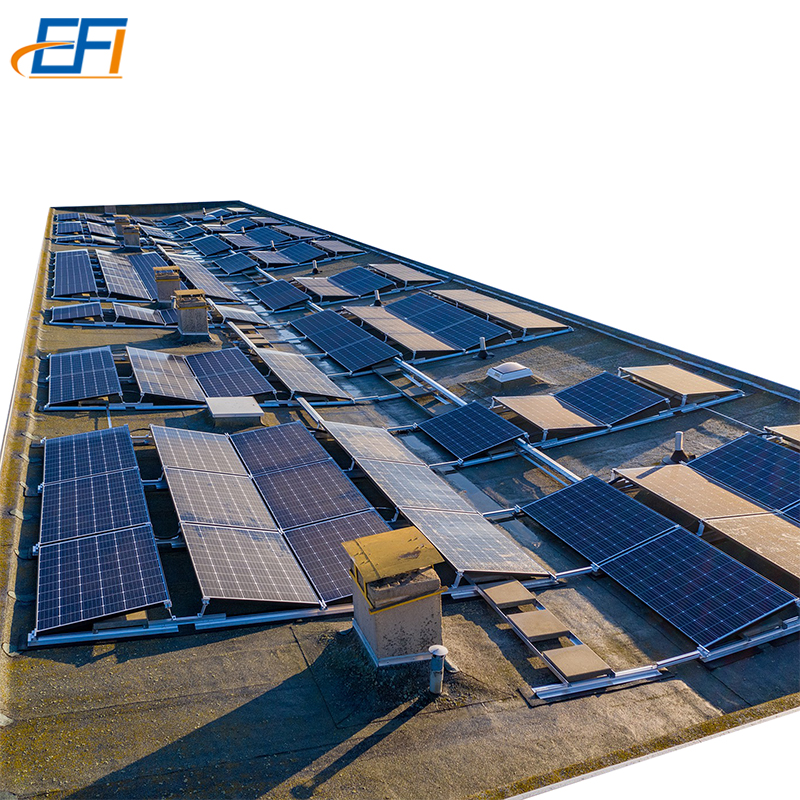
Engineered solar structure components designed to withstand severe wind uplift and static snow loads.
Designing for high-wind environments demands smart aerodynamic mitigation. Wind deflectors play a crucial role here. They block air from rushing under the panels. Optimized array spacing also helps reduce turbulent airflow across the system. These features significantly lower the total uplift forces acting on the array.
Clamping and connection strength dictate system survival. You must evaluate the yield strength of mid clamps and end clamps. Rail splicing techniques and structural fasteners must also meet high-tension requirements. Weak fasteners simply snap during extreme gusts, causing cascading system failures.
Anchoring strategies vary significantly for solar roof mounting. Let us compare the primary options:
Ballasted-only: Relies entirely on concrete blocks. They work well for low-wind areas but slide under high lateral drag.
Attached: Uses direct roof penetrations. They offer maximum pull-out strength but increase leak risks over time.
Hybrid systems: Combine ballast weights with targeted mechanical anchors.
Hybrid systems offer the most reliable risk mitigation. They secure flat commercial roofs in high-wind zones without demanding excessive penetrations. They balance uplift resistance with excellent waterproofing preservation.
Material selection cannot be compromised. High-grade, corrosion-resistant materials are strictly necessary. You should specify G90 galvanized steel or 6000-series aluminum. These premium metals maintain structural integrity over a 25-year lifespan, even in salty or humid coastal air.
Heavy snow regions demand specific design adjustments. First, consider the tilt angle and ground clearance. Optimizing the panel tilt facilitates natural snow shedding. Steeper angles allow gravity to pull snow off the modules efficiently. For ground mounts, you require a higher leading-edge clearance. This prevents snow from piling up and covering the bottom row of panels.
Managing span distances is equally critical. You must reduce the span distance between structural supports. Shorter spans increase the overall load-bearing capacity of the rails. This strategy effectively prevents micro-cracking in the PV modules under heavy snow weight.
We must also address asymmetrical loads. You must design the solar framework to handle uneven snow distribution. Wind drifts push snow to one side of the array. Partial melting and freezing cycles create dense, localized ice blocks. The structural frame must absorb these off-center point loads without warping.
Design Note: In heavy snow regions, standard portrait orientation may increase the risk of frame bending. The long edge of the panel lacks continuous support. Landscape orientation often provides superior load distribution. It allows the reinforced rails to fully support the longer edges of the module.
Design Variable | High Wind Focus | Heavy Snow Focus |
|---|---|---|
Tilt Angle | Lower angles reduce the aerodynamic drag profile. | Steeper angles encourage natural snow shedding. |
Array Spacing | Tighter spacing with deflectors blocks turbulent air. | Wider spacing allows snow to fall clear of the panels. |
Ground Clearance | Lower clearance minimizes under-panel uplift. | Higher clearance prevents snow pile-up at the leading edge. |
Panel Orientation | Often flexible based on roof layout. | Landscape preferred to support the module's long edges. |
Selecting the right structural partner dictates your project's success. You must separate premium engineering partners from basic commodity hardware suppliers. Commodity suppliers sell generic metal extrusions. Engineering partners deliver integrated, site-verified solutions.
Look for robust testing and validation evidence. Independent wind tunnel testing provides the gold standard. Firms like CPP or RWDI test physical models in real airflows. This physical process proves far more accurate than simple computational fluid dynamics modeling alone.
Evaluate their site-specific engineering capabilities. The manufacturer must provide dedicated layout designs. They should deliver PE-stamped structural letters for your exact jurisdiction. They must also supply localized span tables based on your specific roof metrics.
Consider the practical implementation risks carefully. Complex, high-load structures often slow down installation velocity. You should look for pre-assembled components. These smart designs reduce on-roof labor significantly without sacrificing overall strength.
Use these shortlisting steps when evaluating vendors:
Request PE Stamps: Verify engineering letters match your exact site address.
Check Tunnel Data: Ask for independent boundary layer wind tunnel reports.
Review Installation Manuals: Ensure assembly steps suit your labor capabilities.
Procurement Tip: When comparing quotes, calculate the total installed cost rather than just the price per watt. A cheaper racking system might require twice the labor. It might also demand excessive roof penetrations. These hidden installation costs will easily destroy your profit margin.
In regions exposed to extreme wind and heavy snow loads, solar structure design must move beyond standard product selection and focus on site-specific engineering. The structural stability of a solar installation is directly determined by how well the system is designed to withstand local environmental forces. For this reason, compliance with engineering standards, validated testing results, and high-grade materials should always take priority.
A: Static loads refer to constant weights like snow and the equipment itself. Dynamic loads refer to variable, moving forces like wind gusts and seismic activity. Dynamic loads require flexible yet highly secure connection points to prevent material fatigue over time.
A: Wind speeds and uplift pressures increase significantly at higher elevations. A solar structure on a 5-story building requires vastly different engineering and ballast calculations than a single-story warehouse in the exact same zip code.
A: Yes, but it requires calculated engineering trade-offs. For example, steeper tilt angles help shed snow effectively but increase the wind profile and drag. Custom engineering balances these factors using reinforced materials, robust anchoring, and optimized array spacing.

