
PHONE:
0512-58581137 +86-13151198265
E-MAIL:
SKYPE:
zhujingke@hotmail.com
- All
- Product Name
- Product Keyword
- Product Model
- Product Summary
- Product Description
- Multi Field Search

Views: 0 Author: Site Editor Publish Time: 2026-06-15 Origin: Site


Selecting the right physical foundation for your solar array dictates its entire future. It is a critical early-stage decision. It shapes total project cost, long-term energy yield, and maintenance liabilities. Many facility managers struggle to choose between roof and land spaces. A poor choice causes structural damage. It limits power generation. It increases maintenance headaches. You need to know the facts before breaking ground.
This guide provides an objective, side-by-side evaluation of ground-mounted and roof-mounted solar racking systems. It will help facility managers, developers, and property owners make an ROI-positive decision. You will learn the exact trade-offs of both methods. We explore structural realities, cost dynamics, and performance variables. By the end, you can confidently choose a structurally sound path.
Performance vs. Space: Ground mounts offer optimized tilt and orientation for maximum energy yield, while roof mounts capitalize on otherwise unused real estate.
Cost Dynamics: Roof installations typically require lower upfront capital (no trenching or land prep), but ground systems often deliver faster ROI due to higher generation efficiency.
Structural Risks: Solar roof mounting demands rigorous engineering assessments of roof age, load-bearing capacity, and warranty implications.
Scalability: Solar ground mounting provides superior flexibility for future expansion and easier access for operational maintenance (O&M).
Site Constraints: Decision-making must factor in local zoning laws, soil conditions, wind uplift ratings, and snow load realities.
A solar array is only as reliable as the racking system anchoring it. Choosing the correct Solar Structure serves as the physical backbone of your energy project. Poor selection leads to serious business problems. You might face roof leaks. You could compromise your building warranties. You might suffer sub-optimal energy production over the life of the asset.
To make the best choice, we must first define the two primary approaches.
Solar Roof Mounting: These systems attach via mechanical penetrations. Flush mounts work well for sloped surfaces. Ballasted systems secure panels on flat commercial roofs. They utilize your existing building infrastructure.
Solar Ground Mounting: These are freestanding engineered structures. Installers drive them into the earth. Alternatively, they use heavy ground ballast. They allow total control over panel orientation.
You must base your decision on several evaluation criteria. Assess structural integrity. Look at your available footprint. Define your energy consumption goals. Compare upfront capital against lifecycle yield.
Note: Pay close attention to hardware specifications. You might choose aluminum over galvanized steel. Your choice must align with the specific environmental corrosivity of your site. Coastal areas require high-grade anodized finishes. This ensures a 25+ year lifespan without structural degradation.
Many commercial and industrial projects default to the roof. solar roof mounting provides a compelling way to offset energy costs without buying new land.
Roof installations offer immediate spatial benefits. They repurpose unused rooftop space. You never sacrifice valuable land or parking areas. The proximity to existing electrical infrastructure is another huge plus. It minimizes expensive conduit runs. It prevents excessive voltage drop. Furthermore, roof arrays generally face fewer zoning hurdles. They bypass many complex permitting delays compared to ground structures.
Despite the benefits, roofs introduce strict physical boundaries.
Structural Load Limits: You must hire a structural engineer. They verify dead load and wind uplift capacities. Older buildings often fail to support the extra weight.
Roof Age Dependency: Installing a 25-year solar asset on a decaying roof is dangerous. If the roof requires replacement in 10 years, you face massive future costs. You must pay to remove and reinstall the entire solar array.
Sub-optimal Output: The building’s existing pitch dictates your panel angle. The azimuth is permanently fixed. You have limited ability to shed snow naturally. You cannot adjust the tilt for seasonal sun changes.
Best Practice Tip: For commercial flat roofs, evaluate ballasted mounting systems. They use concrete blocks instead of penetrating the membrane. This prevents water leaks. However, ensure the building load capacity can handle the added concrete weight.
When energy generation is the top priority, operators look to the land. solar ground mounting offers unmatched flexibility. It maximizes your investment through peak efficiency.
Ground systems remove the physical limits of a building.
Yield Maximization: You have unrestricted ability to set the ideal azimuth. You can face the panels exactly south or toward the equator. You set the perfect tilt angle for maximum solar irradiance.
Thermal Efficiency: Solar panels lose efficiency when hot. Ground mounts provide superior airflow beneath the modules. This keeps them cooler. It reduces temperature-related voltage drops.
O&M Accessibility: Ground-level access makes operational maintenance incredibly easy. Cleaning panels becomes cheaper. Snow removal is safer. Inverter maintenance happens at eye level.
Bifacial Compatibility: Ground systems sit high above the soil. They are ideal for bifacial panels. These panels generate power from both sides. They capture ground albedo reflection for bonus energy.
Ground mounts require vast open spaces and heavy site preparation.
Footprint Requirements: The array consumes usable land. This permanent footprint may conflict with future facility expansion plans.
Civil Engineering Costs: You cannot simply place panels on dirt. Installers require civil engineering. They need soil geotechnical reports. They must trench for electrical conduits. The land might require extensive grading.
Note: Ground mounting introduces unique permitting variables. You must navigate property line setbacks. Local jurisdictions might require environmental impact studies. You also face local zoning height restrictions.
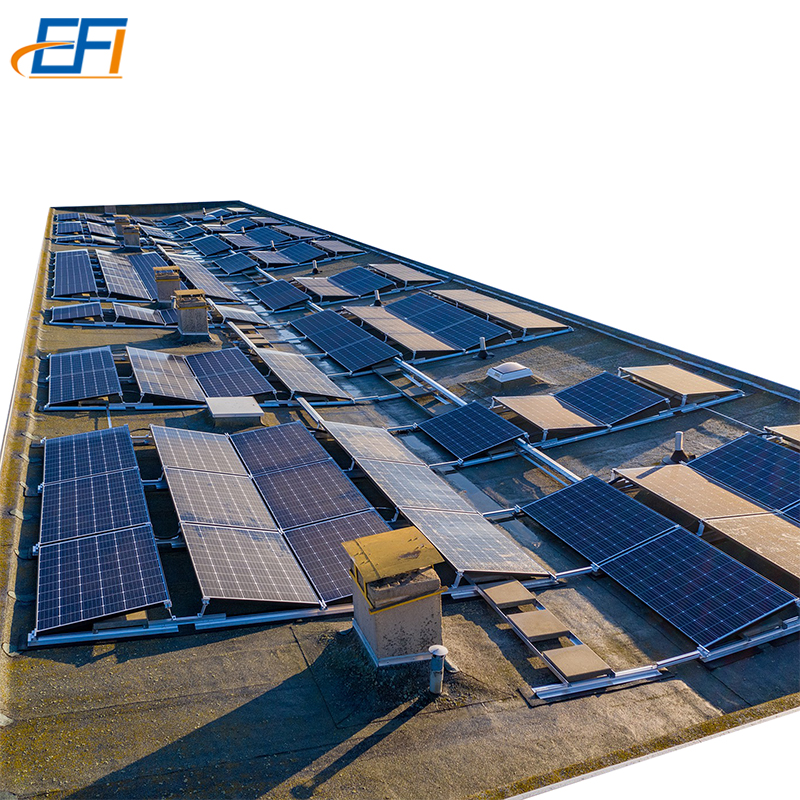
Durable solar mounting hardware ensures long-term stability for both rooftop and ground installations.
Comparing costs requires looking beyond the initial price tag. You must evaluate the full financial lifecycle of the asset.
When you compare hardware and labor costs, roof mounts usually win early. They bypass land prep. They avoid heavy civil work. This makes baseline installation significantly cheaper. Conversely, ground mounts incur heavy early costs. You pay for pile driving. You pay for trenching. Ground-fault protection adds further expenses.
The financial picture changes during the operational phase. Ground mounts have lower long-term maintenance costs. Workers do not need specialized fall-protection gear for basic cleaning. Routine inspections happen faster. Parts replacement takes less labor time.
To find the true winner, model the Levelized Cost of Energy (LCOE). Ground mounts often overcome their higher upfront costs. They achieve this through a 10–20% higher energy yield over 25 years. They capture more daily sunlight. They run cooler. This efficiency difference pays for the initial civil engineering costs over time.
Use the chart below to weigh your priorities.
Evaluation Variable | Roof Mount | Ground Mount |
|---|---|---|
Installation Speed | Faster (utilizes existing structure) | Slower (requires grading and trenching) |
Upfront Cost (CapEx) | Lower | Higher |
Energy Efficiency | Moderate (restricted by roof angle) | High (optimized tilt and azimuth) |
Maintenance Cost (OpEx) | Higher (requires roof safety protocols) | Lower (easy ground access) |
Expansion Potential | Limited by roof square footage | High (dependent on available land) |
Financial Tip: Never calculate the ROI of a roof-mounted system blindly. You must factor in the projected cost of your next roof replacement cycle. If you must remove the array in a decade, your ROI calculation drops dramatically.
Nature and local laws dictate what you can physically build. You must align your structural choice with the environment.
Extreme weather forces engineering adaptations. Roof mounts in heavy snow regions face extreme weight stress. The combined dead weight of snow and solar panels can crush a weak roof. Ground mounts perform better here. Installers elevate them. They pitch them steeply to shed snow efficiently. High-wind zones require strict adherence to ASCE standards. Engineers must secure both systems against massive uplift forces.
The earth beneath your site matters. Ground mounts require secure anchoring. Installers use driven piles, helical piles, or concrete ballast. However, high-rock soil makes driving piles impossible. Highly corrosive soils destroy cheap metal posts. These difficult soil conditions can make ground mounts cost-prohibitive. In these scenarios, the roof becomes the only viable option.
Choosing the right path requires a systematic approach. Follow these three steps to finalize your decision.
Start with a spatial review. Do you have sufficient unobstructed roof space to offset your targeted energy load? Look for HVAC units, skylights, or shading from nearby trees. If the roof space falls short, you must evaluate land availability. Calculate how many acres you can dedicate to an array.
Do not guess about building strength. Commission a formal roof integrity report. Hire an engineer to check the decking and joists. Concurrently, assess local zoning laws for ground arrays. Confirm you can legally trench and install piles on your property.
Numbers drive the final choice. Run parallel financial models. Compare the cheaper CapEx of a roof system against the higher total energy yield of a ground system. Factor in your local energy rates and available tax incentives.
Stop relying on generic estimates online. Engage an EPC (Engineering, Procurement, and Construction) firm today. Ask them for a preliminary site shading analysis. Request a structural baseline assessment to secure real-world data.
Neither solar structure is universally superior. The optimal choice depends strictly on your site realities. You must weigh financial goals against existing infrastructure. Roof mounts maximize tight spaces and lower initial barriers. Ground mounts deliver unmatched energy yields and easier maintenance access.
We emphasize the importance of professional engineering reviews over generic estimates. An aging roof or rocky soil will instantly ruin a poorly planned project. Take the time to gather hard data before you buy hardware.
A: Yes, they are typically 10-20% higher upfront. The extra cost comes from trenching, structural materials, and foundation work. However, ground mounts boast higher generation efficiency. This higher daily energy yield often balances the long-term ROI.
A: It is highly discouraged unless the roof has at least 15–20 years of remaining life. Otherwise, the cost to remove and reinstall the solar array during the roof replacement will completely erode your energy savings.
A: Yes. Ground accessibility completely eliminates the need for specialized roof fall-protection gear. It makes routine cleaning, seasonal snow removal, and inverter component replacement significantly faster and safer for technicians.
A: High-snow regions often favor steep-tilt ground mounts for easier natural shedding. High-wind regions require rigorous structural engineering for either choice. Roof mounts must specifically account for both array uplift forces and the building's underlying structural capacity.

